
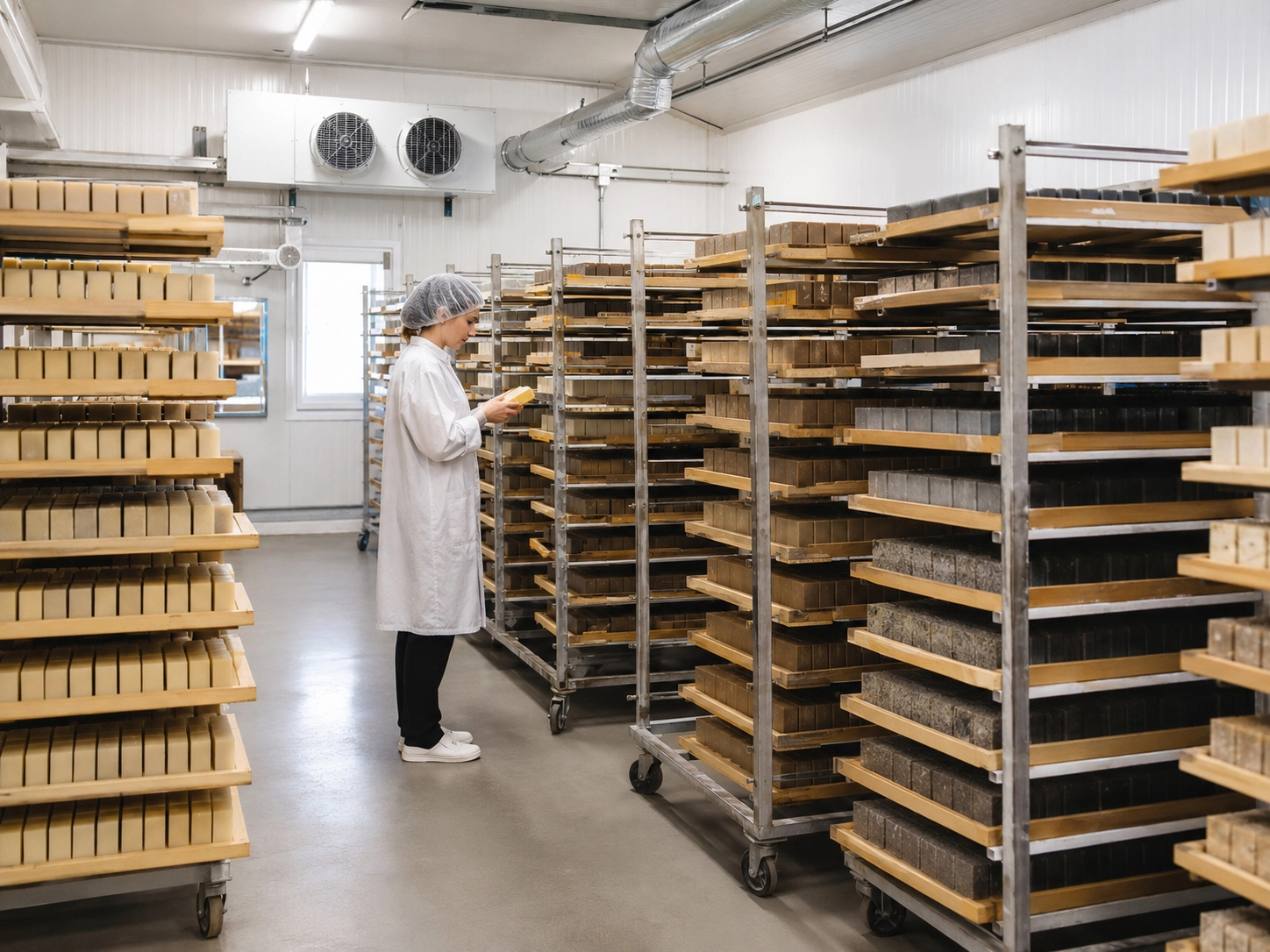
Handmade soap is unusual among consumer products in that it is not finished when it is made. It is finished when it has dried. The weeks between cutting and packing are not a queue, they are a process, and everything the buyer later notices about the bar — whether it is hard, whether it still smells of what was promised, whether it lathers well in month fourteen — is decided during them and then protected, or not, by storage. This guide is about the second half of that story: what happens after the bars leave the curing rack, and how to keep them good until they are sold.
Quick answer: A fully cured cold-process or milled bar keeps well in excess of a year when it is stored cool, dry, out of direct sunlight and with airflow, and when the pack protects it from humidity. Two variables do almost all the damage — temperature and humidity — and two failure modes show up first: scent loss and surface degradation. Because of that, rotation matters more than a nominal expiry figure. Store soap as a stock item with a first-in-first-out discipline, keep the pack closed until the bar is sold, and print a batch code so a slow line can be found before it becomes a write-off rather than after.
Cure time and shelf life are two different clocks
Two durations get confused constantly in soap sourcing, and the confusion produces bad purchase orders. The first is cure: the period after cutting during which water leaves the bar, the crystalline structure settles and residual alkalinity falls. The second is shelf life: the period after packing during which the bar remains acceptable to a customer. They run in sequence, they are affected by different things, and only the second one appears on a label.
| Stage | What is happening to the bar | Typical duration | What ends it |
|---|---|---|---|
| Saponification | The reaction runs to completion inside the mould | 24–48 hours | The bar can be unmoulded and cut |
| Cure | Excess water evaporates, hardness rises, alkalinity settles | 4–8 weeks | The bar is firm, mild and dry enough to pack |
| Packed storage | Weight and chemistry are broadly stable; aroma and surface are the live variables | In excess of a year in good conditions | The pack is opened, or storage conditions go wrong |
| In use | The bar is wet, handled and exposed continuously | Weeks, depending on use | Consumption |
Two consequences follow. A bar that was packed before it was properly cured has lost the chance to dry properly, and no amount of careful storage afterwards repairs it: the shelf-life clock starts from a worse position. And a bar that was cured to a hard, dry standard and then correctly packed is a genuinely long-lived product, which is why a large proportion of the shelf-life conversation is really a packaging and warehousing conversation rather than a formulation one.
The cure period is also why soap orders have an unusual lead time shape. The production step takes days and the cure step takes weeks, so a factory running a curing rack is scheduling capacity rather than machine time. That is the same constraint that sets minimum order quantities, and it is worth reading the two topics together — the MOQ guide explains how rack space enters the quotation.
Temperature and humidity: the two variables that matter
Soap has a long shelf life but not an unlimited tolerance for poor storage. Nearly every storage failure traces back to one of two variables, and the two produce recognisably different symptoms.
| Condition | Effect on the bar | Usually first noticed as | Practical remedy |
|---|---|---|---|
| High humidity, still air | Glycerin migrates to the surface and draws moisture; the bar becomes tacky | Droplets or a sticky film on the surface | Lower the humidity, add airflow, do not stack pallets hard against a wall |
| Heat | Volatile aroma compounds evaporate faster; soft bars can deform under load | Fragrance fades; cartons show pressure marks | Keep away from rooflines, radiators and sun-exposed containers |
| Direct sunlight | Natural colourants and some fragrance components break down | Colour fades or shifts unevenly across a pallet | Store behind an opaque wrap or in a shaded area |
| Air movement over an unwrapped bar | Continued drying; crack propagation at thin edges | Cracking or chipping at corners and embossing | Keep bars in their pack until sale |
| Contact with metal | Discolouration and rancidity at the contact points | Dark spots where the bar touched a metal surface | Use plastic or lined trays and shelving |
The counter-intuitive entry is the first one. A sticky, sweating bar is not a bar that has been stored too wet in the ordinary sense; it is a bar doing what a humectant does. Glycerin is a product of the saponification reaction and is retained in handmade soap, and it attracts water from the air. In a humid, still room it will keep pulling moisture to the surface until the bar feels unpleasant in the hand. Moving air and a drier room fix it; a colder room on its own may not.
The practical storage target is a cool, dry, shaded place with some air movement, and the practical mistake is treating a warehouse corner as neutral space. A pallet stacked under a metal roof in summer, or a carton against an exterior wall, will not have the same conditions as the middle of the same room. If soap makes up a meaningful share of your inventory, it is worth putting a minimum and maximum reading thermometer and humidity metre where the soap actually sits, not where the office is.

Changes that look like faults and are not
A proportion of every claims conversation in this category is about changes that are normal behaviour for a handmade product. Knowing which is which protects both sides: it stops a supplier being blamed for chemistry, and it stops a buyer accepting a real defect because it was explained away as normal.
A surface film or fine white powder on a cured bar is the most common of all. It forms as the bar dries and as free alkali reacts with carbon dioxide in the air. It is cosmetic, it rinses away, and it is more likely on a bar that dried slowly or in moving air. A recipe adjustment and a review of the drying environment reduce it; it is not a reason to reject a shipment.
Weight loss after packing is normal and should have been forecast in the specification. A bar continues to lose a small amount of moisture even after it is wrapped, which is precisely why a declared weight has to be set with a tolerance and why the tolerance has to be checked against the labelling rules of the destination market. A buyer who orders to an exact weight with no tolerance is buying an argument.
Scent that is present but different in the fourth month is the normal trajectory of a natural fragrance rather than a fault. Citrus notes fade first and faster, which is a well-known behaviour of the material rather than a production error, and it is the single best argument for choosing a fragrance system on the basis of how it behaves at twelve to eighteen months rather than how it smells on the approval sample.
Uneven colour between batches is normal where natural colourants are used, and it is worth agreeing an acceptable range in writing rather than a single reference. Where colour fidelity over a long shelf life is a hard requirement, say so before the formulation is fixed — it is a specification decision, not a quality control one, and it is one of the reasons a milled route is sometimes chosen over a cold-process one.
How the pack changes the clock
Once a bar is properly cured, the pack is the main thing standing between it and the two variables above. The choice of format is therefore a shelf-life decision as much as a branding one, and it should be made with the storage and transport route in mind.
| Pack format | Humidity protection | Scent retention | Best suited to |
|---|---|---|---|
| Bare bar, no wrap | None | Lowest — aroma moves freely out of the bar | Immediate local sale, or a bar intended to keep drying |
| Paper band or paper wrap | Low, and it will take up moisture itself | Moderate | Short distribution chains, plastic-free positioning |
| Shrink film | High; the pack becomes the barrier | Highest of the simple formats | Bulk, export, long transit, retail with a long stock cycle |
| Box or sleeve | Depends entirely on whether the bar inside is wrapped | Depends on the inner wrap | Gift and retail sets, where the outer pack carries the branding |
The point that surprises buyers is how strongly the choice interacts with transport. A container crossing a tropical route in summer reaches temperatures and humidity that a domestic warehouse never sees, and an unwrapped bar in a paper band can arrive visibly changed while an identical bar in film arrives untouched. If the same SKU serves a local channel and an export channel, it may be worth specifying the pack per channel rather than per product — an option that costs far less to arrange before the artwork is printed than after.
Batch codes, dates and what to print on the bar
Every storage decision depends on being able to identify a bar. That means a batch code and, in most markets, either a best-before date or a period-after-opening indication. The mechanism is unglamorous, but a programme without it cannot manage stock at all: without a code there is no way to know which pallet is oldest, and without a date there is no trigger to move it.
What to print is best agreed with the supplier at specification stage and reconciled with the destination market's labelling rules, because the required form differs between markets and between a product treated as soap and one treated as cosmetic. What matters practically is that the code is legible at carton level without opening the case, that the same code appears on the invoice and packing list, and that the supplier keeps a record linking the code to the production run. Ask for the batch record with each shipment; it is a single line of data that makes every later question answerable.
One further habit is worth adopting from the food trade. Because scent is usually the first property to change, the useful internal control is not an expiry date printed on a label but a rotation rule applied on the shelf — first in, first out — supported by a review at a defined age. Treat any line approaching the age at which scent has historically faded as a line to promote rather than a line to hold.

Storing bulk stock before it is sold
The buyer's warehouse is where most of the damage happens, because that is where soap spends the longest period without anyone inspecting it. Five arrangements cover almost all of the risk.
Store off the floor and away from walls on plastic or lined shelving, so that neither rising damp nor a cold exterior wall creates a local microclimate. Keep pallets out of the top layer of the building if the roof is uninsulated, since the temperature swing under a metal roof is far greater than at eye level. Leave access aisles so that air moves between pallets rather than sitting in a warm pocket. Keep cartons closed until the bar is picked for sale. And keep a minimum and maximum thermometer and a humidity metre in the storage zone, read on a schedule rather than only when something has gone wrong.
Two smaller points round this out. Do not store soap in the same space as strong-smelling goods such as cleaning chemicals or solvents; the pack is a barrier in both directions, and an unwrapped or paper-wrapped bar will take on odour. And check the carton before it goes into storage: a case that was compressed or crushed in transit can be sound in structure and still have distorted the bars inside, which is far cheaper to identify and claim at goods-in than three months later.
That makes goods-in inspection the hinge of the whole system. Count the cartons, sample the declared weight, open at least one case from each pallet position, and record the batch codes against the location. Fifteen minutes at goods-in is what makes a later claim possible and a later stock rotation simple.
Rotation, and what to do with a slow line
Rotation is the cheapest shelf-life intervention available and the one most often skipped, because it is invisible when it is done well. A simple rule set is enough. Every receipt goes to the back of the picking sequence. Every pick draws from the front. A stock age report runs on a schedule, listing each batch with its age and its remaining quantity. And a threshold age triggers an action — promote, reallocate to a different channel, or bundle into a set — before the bar reaches the point where its scent has historically faded.
Where a line is genuinely slow, the options are worth thinking through in order of cost. Moving stock to a faster channel or a different market is usually cheapest and has no product implication. Bundling slow fragrances into a set moves volume without discounting the hero SKUs. Discounting is the next step, and it is most effective when it is used early — a bar discounted at month six retains most of its value, one discounted at month twenty does not. Reformulation or repackaging is the last resort, and it should not be reached without first asking whether the problem was the product or the storage.
The recurring theme in all of it is that soap rewards discipline rather than technology. Cool, dry, shaded, moving air, first in and first out, and legible batch codes will outperform an elaborate environmental control system that nobody audits.
Storage and stock checklist
- Confirm in the specification that bars are fully cured before packing, and that the declared weight carries an agreed tolerance.
- Agree the pack format against the transit route as well as the brand positioning.
- Agree the batch coding method and confirm the code is readable on the carton without opening it.
- Confirm what dating information the destination market requires and reconcile it with the artwork.
- Set up storage off the floor, away from exterior walls, away from strong-smelling goods and out of direct sun.
- Install a minimum and maximum thermometer and a humidity metre where the soap is actually stored.
- Inspect at goods-in: carton count, sampled weights, one case opened per pallet position, batch codes recorded against location.
- Run a stock age report on a schedule, with a defined age that triggers action.
- Ask the supplier for the batch record with every shipment, and keep it with the goods-in record.
- Review any recurring surface or scent issue against the storage data before raising it as a product fault.
Frequently asked questions
How long does handmade soap actually last?
Well in excess of a year when it is stored cool and dry, provided the bar was fully cured before it was packed and the pack protects it from humidity. Scent is usually the first property to change rather than texture or lather, and it changes faster in a warm, still, sunlit space. Because the change is gradual rather than a cliff edge, stock rotation matters more than a nominal expiry figure on a label.
Why is my soap sweating, and is it ruined?
Almost certainly not. The stickiness is glycerin, which is a natural product of the soap-making reaction and which attracts water from the air. In a humid room with no airflow, that moisture collects on the surface and makes the bar feel tacky. Move the stock to a drier position with some air movement and keep the pack closed until sale. The bar will settle, and no formulation change is usually required.
Should soap be stored in a cold room or a refrigerator?
Neither is necessary, and both carry a risk worth avoiding. A cold room that is also damp will make the sweating problem worse rather than better, because the variable that matters most alongside temperature is humidity. Home refrigerators expose the bar to food odours and repeated temperature swings. The practical requirement is an ordinary store that is cool, dry, shaded and ventilated.
Does the bar lose weight while it is in storage?
A small amount, yes, and that is exactly why the declared weight has to be specified with a tolerance rather than as an exact figure. The loss continues slowly after packing, and the rate depends on the pack format: film holds moisture in while paper and an unsealed band let it out. Agree the weight and the tolerance in writing at specification stage, then check the sampled weight at goods-in against that figure rather than against the artwork alone.
What should be printed so that stock can be managed?
A batch code that can be read on the carton without opening it, plus whatever dating information the destination market requires for the product as classified. Match the code on the invoice and packing list to the code on the carton, and keep the supplier's batch record with your goods-in record. That pairing is what turns a later question about a specific pallet into a short lookup instead of a dispute.
Next steps
Three things decide whether a soap programme holds its quality after delivery: whether the bars were fully cured before packing, whether the pack suits the route the goods actually travel, and whether the buyer's own storage and rotation discipline is written down. The first two are agreed with the factory and belong in the specification; the third is yours, and a thermometer, a batch code and a rotation rule are most of it.
Moonyoo manufactures natural handmade soap across cold-process and hand-milled methods, in four collections — Eastern Harvest & Flora, The Felted Craft Collection, The Gentle Paw Care and Herbal Alchemy Hair Care — with OEM and private-label programmes. Tell us which channels the stock will serve and how long it will sit before sale, and we will recommend the pack format and the curing schedule that suit it. The specification sheet guide explains how cure loss and declared weight are set, and the moulds and weight tolerances brief covers how shape choice affects the same numbers.


