
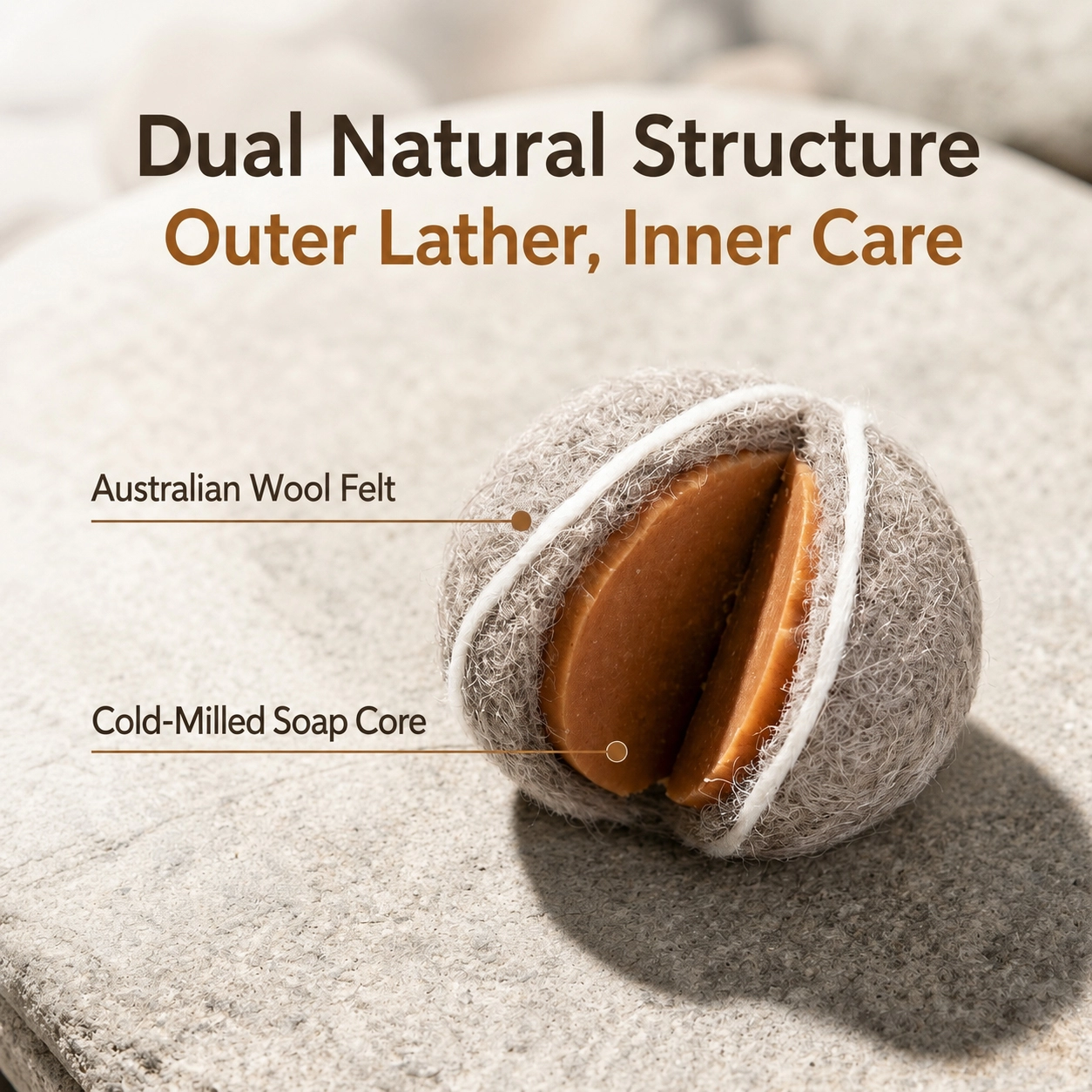
Felted soap is the one category in handmade soap where the decoration is not printed, painted or moulded onto the bar — it is built fibre by fibre around it. That difference is why felted soap resists the copycat problem that follows every flat-printed design, and equally why it cannot be quoted, tooled or quality-controlled the way a conventional bar can. This guide explains how decorative felted soap is manufactured at production scale, where the cost and risk actually sit, and what a brand needs to specify before an OEM programme can be priced.
Quick answer: Wool-felt soap is produced by wrapping a finished cold-process or hand-milled bar in unspun wool fibre, then locking the fibre into a skin with either barbed needles (needle felting, dry, dimensional) or soap, water and agitation (wet felting, smooth, seamless). Production runs sit between 300 and 5,000 pieces per design because the fibre-wrapping step is genuinely hand work. Lead time runs 35-55 days from approved sample to shipped order, and the two cost drivers that surprise buyers most are wool grade and the reject rate created by over-felting.
In this article
- What felted soap is, and what it is not
- Two felting routes, two different products
- Wool sourcing: the decision that sets your ceiling
- Core bar selection and sizing
- Colour, pattern and colourfastness
- How felting behaves at production volume
- Quality control for felted bars
- What to put in the specification
- Lead time, MOQ and cost structure
- Frequently asked questions
What felted soap is, and what it is not
Felted soap is a finished bar of soap with a felted wool skin fused to its surface. The wool is not a wrapper that comes off — the fibre scales are entangled into each other and pressed against the soap surface, so the two behave as one object until the bar is used down. As the soap is consumed, the felt shrinks with it and eventually becomes a small felted scrub pad that outlives the soap.
Three things follow from that construction, and all three matter commercially.
First, it is a handmade product by definition. There is no machine that wraps a bar in wool fibre and entangles the scales. Every piece passes through a pair of hands. This is the source of felted soap's price premium and also the reason its tolerances are wider than a moulded bar's.
Second, the decoration is integral, not applied. A printed bar loses its pattern when the print wears; a felted bar's pattern is the fibre itself, and it abrades slowly rather than flaking. For gift, hospitality and travel-retail channels, that is a genuine functional advantage rather than a cosmetic one.
Third, it is a two-part product with two separate failure modes. The soap core can fail (wrong cure, cracking, sweating, scent loss) and the felt skin can fail (shedding, felting too tight, colour bleeding, detaching). Most first-time felted soap programmes that go wrong go wrong because the buyer specified only one of the two halves.
Where felted soap does not belong: high-volume commodity channels. If your requirement is 50,000 units at a unit cost that competes with a moulded bar, felted soap is the wrong category — the hand labour never amortises away. It is a premium, gift-driven, low-to-mid volume product, and it should be planned as one.
Two felting routes, two different products
Before a felted soap programme is quoted, one decision has to be made: needle felting or wet felting. They use the same raw material but produce visibly different goods, and a factory can rarely switch a design between them without redesigning the artwork outright.
| Dimension | Needle felting (dry) | Wet felting |
|---|---|---|
| How the fibre locks | Barbed needles are pushed repeatedly through the wool; the barbs drag scales past each other and entangle them mechanically | Warm water, soap and friction are applied; the fibre scales open and interlock, then the piece is shocked cold to set |
| Surface result | Dimensional, sculpted, matte with visible fibre direction; relief up to about 3-5 mm | Smooth, dense, seamless, slightly fuzzy; relief under 1 mm and generally flat |
| Best for | Figurative shapes, animals, faces, lettering, petroglyph or script motifs, character goods | Colour-block patterns, stripes, polka dots, marbling, large flat graphics, minimal-look ranges |
| Definition ceiling | Higher — fine detail survives | Lower — fine edge detail blurs into the fibre |
| Hand time per bar | Higher; typically 1.5-2.5x wet felting for the same coverage | Lower |
| Reject mode | Over-needling creates a hard, shiny, compressed patch and can perforate the fibre skin | Over-felting shrinks the skin past the bar, producing a tight, wrinkled or split surface |
| Format fit | Gift box, collector item, seasonal novelty | Retail bar, hospitality amenity, gift set filler |
| Typical unit cost index | Higher | Base |
The practical rule is that needle felting buys definition and wet felting buys consistency. If the design is a recognisable animal or a piece of typography, needle felting is the only route that will hold it. If the design is a repeatable colour pattern that has to look identical across 3,000 pieces, wet felting will hold tolerance far better, because the fibre is drawn into a uniform skin rather than built up point by point.
Mixed construction is common and worth asking about: a wet-felted base skin for structural integrity, with needle-felted detail added on top. It costs more than either route alone but usually beats a single-route compromise when the design has both a large pattern and small focal detail.
Wool sourcing: the decision that sets your ceiling
Felted soap is one of the few soap categories where the raw material is not a soap input. The wool determines the surface quality, the colour range, the allergy story and a large share of the unit cost — and it is the specification field buyers most often leave to the factory.
| Wool type | Felting behaviour | Surface character | Cost | Best used when |
|---|---|---|---|---|
| Merino (fine, 18-22 micron) | Felts fast and densely; tolerant of small errors | Soft, fine, close; reads as premium | Highest | Cosmetic-grade retail, face-adjacent products, gift with a tactile brief |
| Crossbred (25-30 micron) | Moderate; needs more needling or agitation to lock | Slightly coarser; good stitch definition | Mid | General retail bars, patterned designs where definition matters |
| Corriedale / Romney | Reliable, predictable, forgiving | Uniform with mild lustre | Mid | Production workhorses; large runs where consistency beats finesse |
| Coarse / carpet-grade | Felts but stays wiry | Noticeably scratchy; not skin-adjacent | Lowest | Decorative-only goods, car and drawer scent pieces, non-bath novelties |
| Recycled / reclaimed wool | Variable; batch-to-batch behaviour differs | Inconsistent | Low to mid | Sustainability-positioned ranges where the story is the point |
Micron count, not brand name, is the number to fix in a specification. Below roughly 24 micron the wool is generally comfortable against skin; above about 30 micron most buyers describe it as scratchy in bath use, which is why coarse wool belongs on decorative goods rather than on a bar intended for the shower. If your product is positioned for sensitive skin or children, merino in the 18-22 micron band is the defensible choice, and it is also the one that most changes your landed cost.
Two supplier-side questions are worth asking before a programme starts. First, whether the wool is scoured and carded in-house or bought as prepared sliver — this determines how much batch variation you will see. Second, whether the factory holds a fixed wool lot for the duration of a programme. Colour matching across a reorder is straightforward if the same lot is used and close to impossible if it is not, and reorders are where felted soap ranges most often lose their visual consistency.
Batch-lot clause: ask for the wool lot reference to be recorded on the inspection report for each shipment. It costs the factory nothing to write down and it is the only practical way to trace why a reorder looks different from the first order.
Core bar selection and sizing
The felt skin is only half the product. The bar inside it decides how the object ages, and the sizing relationship between the two decides whether the skin stays put.
Core format. Cold-process and hand-milled bars both work, but they behave differently under the fibre. A hand-milled bar is denser and harder, so it holds its shape through the wrapping process and resists the slight surface compression that felting applies. A cold-process bar is softer and more prone to deformation under the same handling, and it needs a longer cure before it can be felted at all — felting a bar that is still losing water means the skin will loosen as the bar shrinks away from it.
Cure before felting. This is the single most common scheduling error in felted soap production. A cold-process bar needs its full cure window — typically 4 to 6 weeks — before the fibre goes on. Ship a felted bar made from an under-cured core and the skin will wrinkle and detach in transit or on the shelf. The practical rule is that felting is the last operation, never a step used to hide curing time.
Sizing. The felt skin must be applied slightly undersized relative to the finished bar, so that it is under tension when it sets. A skin that is too loose will slide and shed; a skin that is too tight will split at the edges or distort the bar underneath. Target figures vary by design and wool, but a workable starting point is a finished felted bar 6-12% larger in each dimension than the bare core, with the tolerance agreed against a physical approved sample rather than a drawing.
| Core bar | Typical felted finished weight | Notes |
|---|---|---|
| 60 g core | 72-85 g | Small travel or amenity format; needle detail is very tight at this scale |
| 80 g core | 95-110 g | Common gift-set filler |
| 100 g core | 118-138 g | The workhorse retail format for felted soap |
| 120 g core | 140-165 g | Premium single bar; best surface area for detailed design |
| 150 g core and above | 175 g+ | Novelty and decor pieces; check shipping weight maths before committing |
Weight must be declared as a finished, packaged figure with a tolerance, and it must be checked after curing and after felting — not calculated from the core. A felted bar that gains 10 g of wool can still weigh less than a bare bar of the same nominal size if the core was cut light. Agree the measurement point in writing: bare core, post-cure, post-felting, or packed and ready to ship.
Colour, pattern and colourfastness
Wool colour comes from dyed fibre, and the felting process is wet and alkaline. That combination makes colourfastness a specification item, not an afterthought.
Dyed-lot consistency. Wool is dyed in lots and lots do not repeat exactly. Fix a dyed lot per programme and accept a stated tolerance against a physical colour standard rather than a Pantone reference alone — fibre reads colour differently from a flat coated surface, and a Pantone match on paper will not predict how the same number looks once carded into fibre.
Colour bleeding. This is the failure buyers notice first, because it shows up in the packaging. Wool dyes can migrate into the soap surface and into adjacent fibre blocks when the bar is used, or even in storage under humid conditions. Insist on a wash test on the finished felted bar, not on the loose fibre: soap the bar, agitate it in warm water for a defined interval, and check both the run-off water and any light-coloured fibre blocks for transfer.
Pattern execution. Pattern is the designer's decision, but the choice of route constrains it. Wet felting reproduces large flat shapes and colour blocks faithfully and fine line work poorly. Needle felting reproduces line work and small motifs faithfully and costs more per unit for any given coverage. A pattern brief that mixes both — a large background block with small figurative detail — is the case that justifies the mixed construction described earlier.
Decorative-only components. If a design includes beads, embroidery, felted balls or non-soap ornaments, confirm that they are stitched or felted in rather than glued, and that they carry no sharp edges. This is a compliance point as much as an aesthetic one: small detached parts are a documented hazard in children's and bath products, and an ornament that comes loose in the shower is a complaint waiting to happen.
How felting behaves at production volume
Felted soap does not scale the way moulded soap does, and setting a volume expectation that ignores this is how programmes end up late.
The hand-labour ratio is fixed. Felting time per bar is roughly proportional to surface area and fibre density, and it does not compress meaningfully with volume. A team of fifteen felters produces roughly fifteen felters' worth of output; adding people is how a factory raises capacity, not by speeding up an individual. This is why felted soap factories grow in workforce rather than in machinery.
Piece rate governs the quotation. Felted soap is priced per piece at a designed rate, and a design that takes twice as long to felt costs roughly twice as much, regardless of how simple the core is. Reducing hand time is therefore a design decision: larger flat colour blocks instead of small repetitive motifs, fewer colour changes, and a single-side decorated bar instead of a fully wrapped one can each cut labour materially.
Definition traps. The two production failure modes are mirror images. Over-needling compresses the fibre into a hard, almost shiny patch that will not accept further fibre, and at worst perforates the skin. Over-felting under water shrinks the skin past the bar, so the finished piece is wrinkled, split at the corners, or visibly strangled. Both are functions of time-on-task, which means both are managed by training and inspection rather than by specification alone.
| Volume band | What it means commercially | Practical implication |
|---|---|---|
| Sample to 300 pieces | Trial or launch run | One or two felters; design is still adjustable; unit cost is highest |
| 300-1,500 pieces | Standard launch order | Dedicated team assigned; a full first-article approval is worthwhile |
| 1,500-5,000 pieces | Established programme | Design must be frozen; colour lots fixed; schedule built around felters' availability |
| 5,000+ pieces | Above the comfortable band for a single design | Split across two or three designs, or plan in waves tied to felt-team capacity |
Schedule against the felt team, not the calendar. Ask how many felters will be assigned to your design and what their daily piece output is at the required definition level. That single number predicts your delivery date more accurately than any general lead-time figure.
Quality control for felted bars
Inspection criteria for felted soap need to be agreed before the first production run, because "looks right" is not an acceptance standard a factory can hold across 3,000 pieces by hand. Six checks cover the failure modes that matter.
| Check | Method | Acceptance | Reject indicator |
|---|---|---|---|
| Fibre adhesion | Flex the bar gently and rub the surface with a wet thumb | Fibre stays locked; no visible lift at edges | Shedding fibres on the hand, edge lifting |
| Skin tension | Measure finished dimensions against the approved sample | Within agreed tolerance on all three axes | Loose sliding skin or splitting at corners |
| Colour transfer | Wet-soap and agitate for a set interval; inspect run-off and light fibre | No visible transfer to water or adjacent blocks | Tinting of run-off or bleeding into pale blocks |
| Felt thickness | Measure at three defined points per bar | Within stated range; relief consistent on needle-felted detail | Bare patches, thin spots, hard compressed patches |
| Core integrity | Cut one bar per lot | Core solid, evenly cured, no cracking or soft centre | Cracking, cavity, visible moisture, uneven cure |
| Finished weight | Weigh packed finished piece | Within declared tolerance band | Outside band, or batch mean drifting low |
Two operational points make these checks workable. First, inspection should be on the packed finished piece, not the bare core, because felting changes both weight and dimension. Second, the approved sample is the standard — a physical counter-sample held by both parties, photographed under fixed lighting, referenced in the purchase order. Digital images alone do not resolve colour and texture disputes on a fibrous product.
What to put in the specification
A felted soap brief differs from a standard soap brief in nine fields. Miss any of them and the quotation will come back as a range rather than a price.
- Core specification — base formulation, process route (cold process or hand-milled), cure window completed before felting, bare core weight with tolerance.
- Felting route — needle, wet, or mixed, with the reason stated if the design could go either way.
- Wool type — micron band, breed or blend, and whether a fixed lot is required for the programme duration.
- Colour direction — dyed fibre references, tolerance against a physical standard, and the required wash-test result.
- Pattern artwork — vector or high-resolution file, with an explicit statement of which elements need needle definition and which may be wet-felted.
- Finished dimensions and weight — measured on the packed piece, on all three axes, with the tolerance band.
- Surface and finish standard — target texture, and an explicit note on whether a visible fibre direction or a brushed-down finish is wanted.
- Packing — inner protection for a fibrous surface, and whether the felted bar needs a moisture barrier given the destination climate.
- Quantity, timing and delivery term — order quantity by design, requested ship window, and Incoterm.
The one field that most changes your price: the required finished dimension tolerance. Tightening it from ±5% to ±2% on a hand-felted product does not make the factory more careful — it makes it reject more pieces, and the reject rate is passed back to you in the unit cost. Set the tolerance from what the channel actually needs, and no tighter.
Lead time, MOQ and cost structure
For a first felted soap programme with a new design, plan on the following. Figures assume the specification is approved and artwork is production-ready; they exclude iteration cycles.
| Stage | Duration | What can go wrong |
|---|---|---|
| Core bar trial and cure | 30-45 days | Under-curing to save schedule is the classic error; the felt skin will not survive it |
| Wool sourcing and lot fixation | 7-20 days | Speciality micron bands may not be on the shelf; a lot change mid-programme breaks colour |
| Design adaptation to felting route | 5-12 days | A pattern that works in print may not survive fibre; this stage is where designs get reworked |
| Sample felting and first-article approval | 10-20 days | Two to three iterations are normal on a first design |
| Bulk felting | 15-35 days | Governed by felt-team capacity, not by order size alone |
| Packing and inspection | 3-7 days | Understated if the packing includes hand-fitted inserts |
| Documentation and despatch | 3-10 days | Add time if certificates or specific label formats are needed |
Sequential total: roughly 8 to 14 weeks for a first programme. Parallel paths — starting wool sourcing while the core cures — can compress this to 6-9 weeks, and asking for that parallelism is a reasonable request on an established relationship.
MOQ. Hand-felted soap does not follow the MOQ logic of moulded soap. There is no tooling to amortise on the felt side, so a factory's minimum is set by felt-team scheduling rather than by a machine setup. Low hundreds is achievable for a simple wet-felted design and a clean core; complex needle-felted figurative work commonly starts around 500 pieces. The MOQ generally applies per design and per colourway, not per order.
Where the cost actually sits. In a felted soap programme, hand labour is usually the largest single component — commonly 40-55% of unit cost — with wool fibre next. The soap core, in contrast, is often a smaller share than buyers expect, because it is the part the factory is best at. This is the opposite of a conventional soap programme and it explains why felted soap quotations reacted so little to base-oil price movements while reacting strongly to design complexity.
Frequently asked questions
Is felted soap a real product or a novelty?
It is a real product with a documented retail category. The felt skin is functional: it is a built-in washcloth with mild exfoliating action that outlives the soap, and it shrinks with the bar rather than slipping off it. The novelty association comes from how it is often marketed, not from how it is built.
Can felted soap be made from any bar we already sell?
Usually yes, with two conditions. The bar must be fully cured before felting — cold-process bars need their complete cure window — and the bar should be dimensionally stable, because a core that shrinks after wrapping will loosen the skin. Milled and dense bars wrap most reliably.
Which wool should we choose?
For bath use on skin, merino or a fine blend in roughly the 18-24 micron band. For decorative pieces that are not meant for the shower, a cheaper coarse wool is defensible. Coarse wool above about 30 micron is generally perceived as scratchy in bath use and should not be specified for a product positioned on softness or sensitive skin.
Will the colour bleed?
Not if the fibre is correctly dyed and the finished bar passes a wash test. Colour transfer is a specification item, so require a wash test on the finished felted bar — not on loose fibre — and set an acceptance criterion before production. Most bleeding complaints trace back to a wash test that was never performed at sample stage.
How long does felted soap last?
Longer than the bare bar it wraps, because the felt continues as a scrub pad after the soap is gone. Shelf life follows the core bar's own shelf life, provided it is stored dry. High humidity is the main risk to a felted bar in storage, which is why inner packing and a moisture barrier matter more here than on a bare bar.
Can we get a low MOQ to test the market?
Low hundreds is realistic for a simple wet-felted design on an existing core. Below that, the wool lot and the felt-team scheduling become the limiting factors rather than the labour itself, and some factories will decline rather than interrupt other production for a very small run.
What is the single most common mistake on a first felted soap order?
Compressing the core curing time to protect the schedule. It is invisible at sample stage, it passes inspection, and it produces a wrinkled or detached skin weeks later in the customer's hands — after the goods have shipped and the packaging has been printed.
Planning a felted soap range?
We manufacture wool-felt decorative soap in both needle-felted and wet-felted routes, on cold-process and hand-milled cores, from sample through to production runs. Send us your design intent and target channel and we will come back with a route recommendation and an indicative cost range.
Read next
If you are still choosing a core bar for the programme, our comparison of cold-process and hand-milled soap explains what each route does to hardness, cure time and surface behaviour under the fibre.