

Hotel amenities, spa retail lines and gift sets look like three different businesses, but they share one defining characteristic: they are bought again. An amenity programme that cannot be reordered to the same standard is not a programme, it is a one-off order with a nice presentation. This guide is about building a custom range that survives its second, third and tenth purchase order.
Quick answer: Design the range backwards from the reorder. Fix a small fragrance library and a single pack format family before you design individual SKUs, because those two decisions are what make replenishment practical. Then standardise the label data set across the range so that adding a SKU later does not require new compliance work.
Why amenity ranges fail at the second order
A first order is a project. A second order is a process. Projects tolerate improvisation — a slightly different scent because the reference was never written down, a slightly different pack because the original was out of stock. Processes do not, because the whole value of an amenity range to the end customer is sameness. A guest who returns to a hotel expects the same soap. A spa client who buys the retail bar expects it to smell like the one in the treatment room.
Three failures account for most of the second-order problems we see. A fragrance reference was never recorded, so the reorder is matched by memory. A pack format was chosen because it looked good on the first pallet but cannot be produced at the required reorder quantity. And a label data set was compiled line by line for the first SKU, so adding a second SKU means redoing the whole compliance exercise rather than extending an existing framework.
All three are solvable at design stage and expensive afterwards. The rest of this guide is ordered to solve them in the right sequence.
Hotel, spa and gift retail compared
The three channels look similar on a shelf and behave very differently operationally. The table below sets out what each one actually requires from a custom range.

| Dimension | Hotel amenities | Spa retail | Gift / private label sets |
|---|---|---|---|
| Order rhythm | Regular, predictable, tied to occupancy | Seasonal, tied to retail sell-through | Event-driven — holiday, corporate, gifting |
| SKU range | Narrow — often one or two core bars | Wider — a retail assortment with variants | Mixed — sets assembled from components |
| Pack format | Functional, often minimal or naked with a band | Retail-ready, shelf-facing | Presentation-led, boxed |
| Fragrance | One signature scent, repeated for years | Several scents, changed with collection | Theme-led, frequently seasonal |
| Key risk | Reference drift between orders | Pack format that cannot be reordered | Missing the seasonal window |
| Success factor | A frozen specification and a retained sample | A stable core range plus seasonal layers | Long lead-time planning and component reuse |
Read across the key-risk row. Each channel fails for a different reason, and each failure has a different design countermeasure — which is why the same range architecture is not optimal for all three.
Designing the SKU ladder
Build the range as a ladder rather than as a flat list, so that each level reuses the level beneath it. This is the single most useful piece of structure for keeping a custom programme manageable.
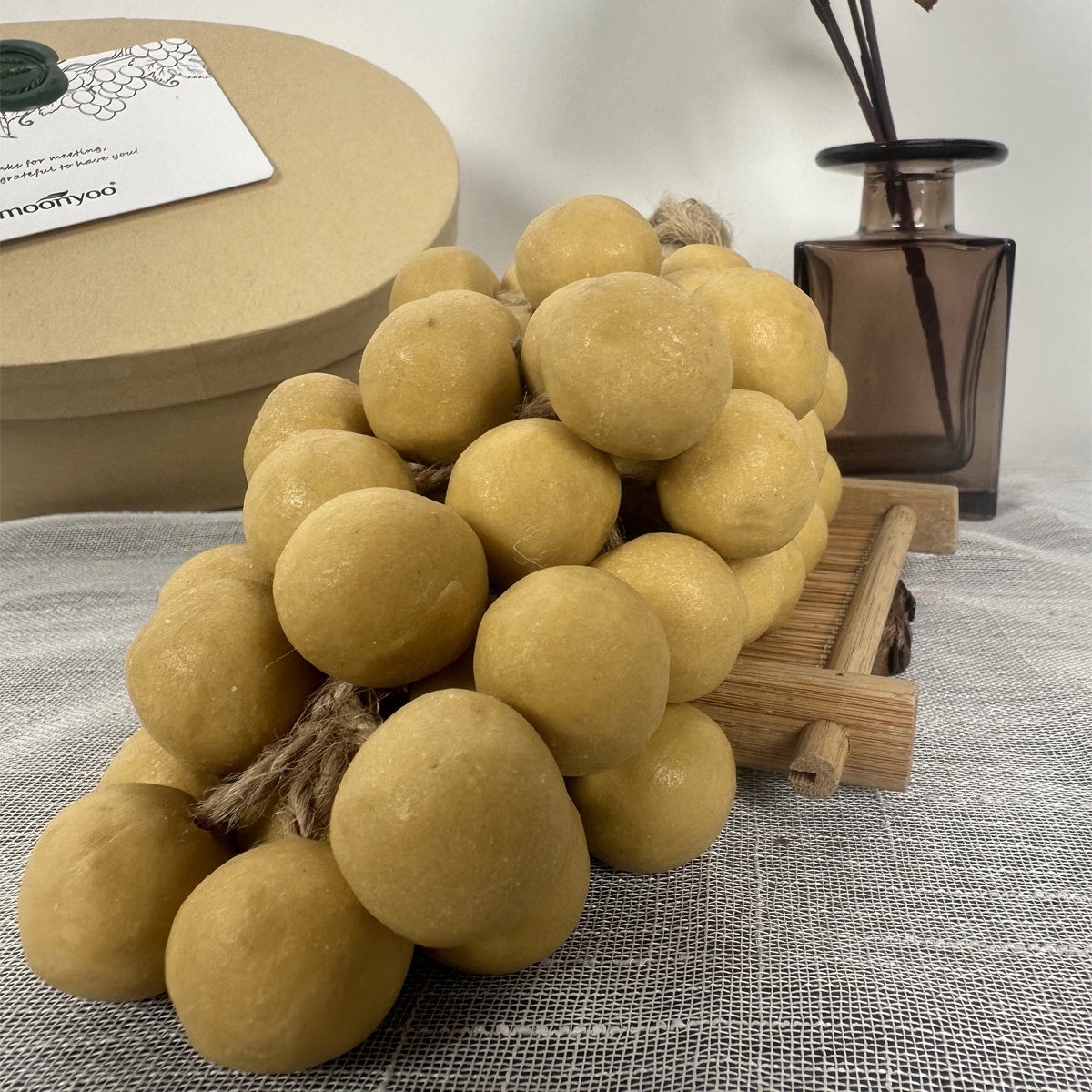
Level one — the core bar. One fragrance, one pack, one weight. This is the workhorse of the programme and the item that will be ordered most often. It should use the simplest reliable pack and the most reproducible finish, because it carries the highest reorder volume.
Level two — core variants. The same bar in additional fragrances or additional weights. Because the body and the pack are unchanged, adding a variant is a fragrance and label change rather than a new product. This is where a fragrance library pays for itself.
Level three — format extensions. The same brand language in a different physical format — a larger bar for retail, a smaller guest size for amenities, a shaped or decorated bar for gifting. These share fragrance and artwork but require their own tooling and their own weight specification.
Level four — assemblies. Gift sets and collections built from components already in the range. Level four should ideally introduce no new soap at all; that is the point of standardising the levels below it.
A well-built ladder means a new seasonal collection can be launched by assembling existing components with a new sleeve, rather than by commissioning new soap, new tooling and new compliance work.
Building a reusable fragrance library
The fragrance library is the most valuable asset in a repeat amenity programme, and it is the one most often left undocumented. A library is simply a defined set of scents, each with a fixed reference and a fixed load rate, that any SKU in the range may draw on.
Keep the library small. Three to five core scents is enough for most programmes and keeps both sourcing and stock simpler. For each entry, record the scent reference or formulation, the load rate as a percentage of finished weight, the allergen declaration status, and a sealed retained sample.
The retained sample is doing the heavy lifting here. A photograph cannot communicate a scent, and a written description is at best an approximation — "green and herbal" covers a very wide range. A sealed physical sample is the only reference that reliably reproduces the original across a multi-year programme.
If the range needs seasonal variety, add seasonal scents as a separate layer that references the core library rather than replacing it. That way the core range stays stable while the seasonal layer rotates, and the guest or client never experiences the core product changing under them.
| Fragrance library decision | Recommended practice | Why it matters at reorder |
|---|---|---|
| How many core scents | Three to five, held constant | Small libraries are easier to source and to stock than wide ones |
| How each scent is recorded | Reference or formulation plus load rate | A number reproduces; a description does not |
| How each scent is anchored | Sealed physical retained sample | A photograph cannot communicate a scent across a multi-year programme |
| How seasonal variety is handled | As a separate rotating layer above the core | The core stays stable so returning clients meet the same product |
Pack formats and presentation
Choose the pack format family before designing individual packs, and choose it partly on reorder practicality rather than purely on appearance. A pack that requires a bespoke box manufactured to a long lead time may be perfect for a launch and impossible for a mid-season top-up.
The practical options for a custom range are a wrapped bar, a paper sleeve or band, a kraft or rigid box, and a naked bar for in-room or in-treatment use. Two rules make these easier to manage across a range: use one pack format per channel, and keep the artwork template constant across the range so that adding a SKU means filling a template rather than designing a pack.
For gift assemblies, specify the carton and the internal fit at design stage. A set that moves slightly during transit will arrive with prematurely worn decoration, and the fix is a revised internal fitment rather than more cushioning.
Storage, shelf life and replenishment
Soap has a long shelf life but not an unlimited tolerance for poor storage. The two variables that matter are temperature and humidity, and the two failure modes are scent loss and surface degradation.

| Condition | Effect on soap | Practical requirement |
|---|---|---|
| Cool and dry | Stable; scent and surface hold well | The intended storage condition for any programme |
| Warm | Accelerated fragrance loss and softening | Avoid storage near heat sources or in unventilated areas |
| Humid | Surface takes on moisture; wrapping can mark | Keep wrapped stock sealed until use; avoid damp stockrooms |
| Direct light | Colour change, particularly on natural colourants | Store boxed or shielded; avoid sunlit display stock |
| Long idle periods | Scent fades even when the bar remains sound | Rotate stock; order to a realistic consumption cycle |
For hospitality use specifically, match the order quantity to the consumption rate rather than to a price break. Stocking a two-year supply to secure a better unit price is usually a false economy if a meaningful part of it fades before it is used. Where a price break makes a larger order attractive, confirm the sealed shelf life of the pack format before committing.
Making the reorder repeatable
A repeatable programme rests on four things, and none of them are expensive.
First, a frozen specification document for each SKU, covering formula, weight and tolerance, fragrance and load rate, pack and label data. Second, sealed retained samples and scent samples. Third, a stable fragrance library with fixed references. Fourth, the artwork in an editable format, held by you as well as by the manufacturer.
With those in place, a reorder becomes an instruction rather than a development project. That difference is visible in the lead time, and it is usually visible in the price as well, because a factory quoting a known specification carries less uncertainty than one quoting a description.
Frequently asked questions
How many SKUs should an amenity range have?
Fewer than instinct suggests. Most successful programmes run a small core — often one or two fragrances — with variants layered on top rather than a wide flat assortment. Each additional core SKU multiplies the specification, stocking and compliance work without necessarily multiplying sales.
How long does a handmade soap bar keep?
Well in excess of a year when stored cool and dry, provided the bar is fully cured before packing and the pack protects it from humidity. Scent is usually the first thing to change, which is why stock rotation matters more than a nominal expiry figure.
Can the same soap serve both hotel and retail channels?
Yes, and it is common — but the pack and the weight usually differ. A guest-size bar for in-room use and a retail-size bar for sale share the fragrance and the brand language but need separate weight specifications and separate label panels. Plan both at design stage so the tooling and the fragrance library accommodate both.
What causes colour to differ between two orders of the same product?
Usually an unrecorded reference. Natural colourants shift with cure time and light, so a reorder matched against a photograph taken at first production may be matched against a colour the bar no longer is. Keep a sealed physical sample and compare against that, at the packing point rather than before curing.
How far ahead should seasonal gifting collections be planned?
Further than most first-time buyers expect, because the constraint is not production speed but the combined lead time of tooling, first-article approval, printing and freight. Start the specification early enough that the season is a delivery date rather than a deadline, and build the set from components that already exist.
Next steps
Sketch your range as a four-level ladder and check that each level reuses the level beneath it. Then define a small fragrance library with written references and sealed samples, and settle on one pack format family per channel before any individual pack is designed.
For the adjacent topics, see our guides on fragrance and essential-oil matching and on export-ready packaging and documentation.