

Ask a soap factory for "the certificates" and you will usually receive a folder, not an answer. Some of what arrives is about the company, some is about a specific bar, and some is a declaration about a claim printed on your label. They are issued by different bodies, they expire on different clocks, and only one of the three is capable of stopping your product at a customs post. Knowing which is which turns a pile of PDFs into the two or three documents your market actually requires.
Quick answer: Soap supply documentation falls into three families. Company-level certificates describe the factory and its systems — quality management, good manufacturing practice, environmental and social audits. Product-level test reports describe a specific formulation: microbiological results, heavy-metal and impurity screening, stability and compatibility work. Declarations state something you intend to print on the label, such as vegan, cruelty-free or palm-free. Build the paperwork around what your market asks of a brand, then ask the factory for exactly those items by name. A document that is not requested by name is the document most likely to be missing when you need it.
Certificates, test reports and declarations are three different things
The confusion starts with language. In everyday sourcing conversation the word "certificate" covers all three families, and suppliers follow the buyer's vocabulary. The distinction matters because the three are not interchangeable, and a buyer who accepts one in place of another discovers the gap at the least convenient moment.
| Family | Issued by | What it establishes | What it does not establish |
|---|---|---|---|
| Certificate or system audit report | A certification body or an audit house | That the factory's management system, premises or process met a defined standard at the time of audit | Anything at all about the specific bar you have ordered |
| Product test report | An accredited laboratory, on a submitted sample | That a particular formulation, as sampled on a particular date, met stated limits for the tests performed | That batches made later are identical, or that other tests would also pass |
| Declaration or statement of compliance | The manufacturer, on its own authority | What the manufacturer asserts about the material or process — for example that no animal-derived ingredient was used | That an independent party has verified the assertion |
The practical consequence is a rule you can apply immediately: never accept a company-level certificate as evidence about a product, and never accept a product test report as evidence about a process. They are answering different questions. A quality management certificate tells you the factory is organised; it tells you nothing about whether the fragrance you chose is within the allergen threshold you need.
Company-level documents and what they cover
Company-level documentation is what a buyer should collect before placing a first order, because it is cheap to obtain and it screens out suppliers who cannot support an export programme at all. Four kinds appear most often in this category, and they are worth understanding in terms of the different risks they address.
Quality management certification addresses consistency: documented procedures, records, corrective action, internal audit. It is the document that makes a claim like "the third order will match the first" testable rather than a promise.
Good manufacturing practice documentation addresses hygiene and contamination control: premises, personnel, equipment cleaning, batch records, traceability. For a cosmetic-type product this is the family of documentation that a retail customer or a distributor is most likely to ask you for, and it is usually requested at the brand's own supplier-approval stage rather than by a regulator.
Environmental and social audit documentation addresses buyer risk in markets where retail chains publish supplier lists. It is increasingly requested alongside quality documents by larger customers, and a supplier who already holds it is a supplier you can grow with.
Export capability documentation addresses the practical question of whether the factory can ship to your market at all. Moonyoo states that certificates for exports to the United States and Europe can be provided, and that it maintains domestic and international service points with round-the-clock technical support. What you should ask for in addition is the specific set your destination requires — an answer phrased as "we can provide ISO, certification and other documents on request" is an invitation to name what you need, not a substitute for naming it.
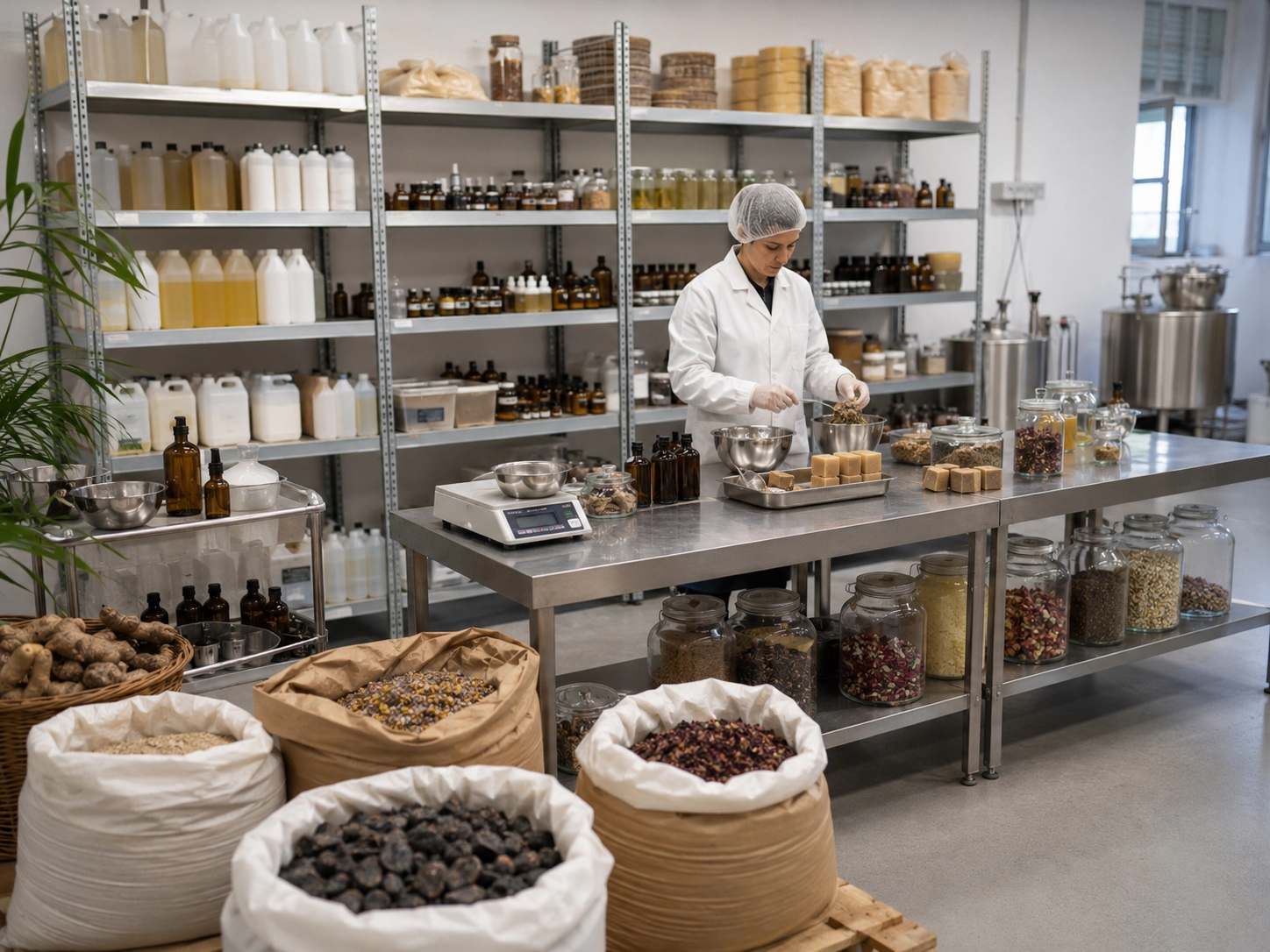
Product-level test reports
Product testing is where a handmade soap programme diverges most sharply from the packaging and labelling template that buyers bring from other categories. The reason is that soap sits at the boundary between two regulatory worlds: in some markets a cleansing bar is treated as cosmetic, in others as soap with a different regime, and the test set follows from that classification rather than from the product itself.
| Test or assessment | What it examines | Usually triggered by | When it is needed |
|---|---|---|---|
| Microbiological testing | Total aerobic count and absence of specified organisms | Any product with water contact, botanical inclusions or a long shelf life | Before a first bulk order, and on a defined re-test cycle |
| Heavy-metal and impurity screening | Lead, arsenic, cadmium, mercury and similar limits against a stated specification | Colourants, clays, mineral additives and imported botanical ingredients | Where a destination market sets limits, or a retailer requires a report |
| Stability and compatibility work | Whether the bar's colour, scent, texture and weight hold over time and in its packaging | New fragrance, new colourant, new packaging format | At the development stage, before artwork is printed |
| Allergen content of the fragrance or essential-oil blend | Which declarable fragrance allergens are present and at what level | Every fragrance change, and every market with an allergen labelling requirement | Before the label artwork is approved |
| Migration and contact testing | Whether the wrap, box or label interacts with the bar | A new packaging material or a change of supplier | Once per packaging format |
Two points about this table are routinely misunderstood. The first is that a test report is a snapshot: it describes the sample submitted, on the date it was submitted. It is not a warranty that subsequent batches are identical, which is why a re-test cycle belongs in the specification rather than being left to chance. The second is that the largest single driver of testing cost is not the test, it is the number of variants. Nine fragrances in three packaging formats is potentially a great deal more testing than three fragrances in one format, and the testing budget should be planned against the range, not against the order volume.
Because a formulation-level assessment belongs to whoever places the product on the market, the practical division of labour is worth stating plainly. The factory supplies the formulation data, the ingredient information and the test reports it holds. The brand assembles those into whatever the destination market requires, and where the market requires an assessment signed by a qualified assessor, that assessor works from the factory's data pack. A supplier who can produce a complete, well-ordered data pack is worth more than one who cannot, even at a higher price per bar.

Declarations that support a marketing claim
The third family is the one buyers most often overlook, and the one that causes the most difficulty later. Any claim printed on a soap label — vegan, cruelty-free, palm-free, natural, no preservatives, biodegradable — is a statement you are making to a consumer, and it has to be supportable. Most suppliers will provide a declaration in writing, but a declaration is only as strong as the process behind it.
What to ask for behind each common claim
- Vegan — a written statement covering every ingredient, including the fragrance blend; fragrances are the usual place where an animal-derived material appears.
- Cruelty-free — a statement about testing, not about ingredients; ask specifically whether the finished product or any ingredient was tested on animals by the supplier or on its behalf.
- Palm-free or sustainably sourced palm — a sourcing statement with the derivative names listed, since palm derivatives appear under many chemical names in a soap recipe.
- Preservative-free or additive-free — a full ingredient list to support it, plus an acknowledgement from the supplier of what the claim implies for shelf life and storage.
- Biodegradable or plastic-free — a statement about the bar and the packaging separately; they are governed by different evidence.
Note the internal tension in the fourth line. A bar with no preservative system has a shorter and more tightly conditioned life than one with it, and a supplier asked to state "preservative-free" should be expected to say so. That is not a reason to avoid the claim; it is a reason to make the storage and dating rules in the specification more precise, in writing, rather than less.
Label data: INCI, allergens and dating
Most of the questions that arrive after a first shipment are label questions, and almost all of them could have been answered at the artwork stage. The data set belongs in the specification sheet from the beginning, and it has four parts.
The ingredient list in the order the market requires, declared by the name that market recognises, is the foundation. The declarable allergen statement follows from the fragrance or essential-oil blend and must be reconciled with the ingredient list rather than added as an afterthought. The net content — a weight, in the unit the market uses — has to agree with what the line fills to, which connects the label directly to the weight tolerance agreed with the factory. And the identification and dating information must let a buyer trace a bar back to a batch, which usually means a batch code plus either a best-before date or a period after opening.
Two practical notes. First, if one label is intended to serve several markets, expect to concede something: a single artwork that satisfies every destination is rare, and the attempt usually produces a label that satisfies none of them completely. Second, have the artwork checked against the specification by the same person who wrote the specification, not by the designer. Label errors are almost never artistic; they are numerical and terminological.
What the destination market asks of a brand
The document set a brand needs is defined by where the product is sold, not by where it was made. The same bar can require a substantial file in one market and almost nothing in another, and it is worth being explicit about that before ordering, because it is the brand, not the factory, that carries the obligation.
| Destination | What is typically required of the brand | What the factory needs to supply |
|---|---|---|
| European Union | A cosmetic product safety assessment and a market notification before the product is placed on sale, held by a responsible person established in the market | Full formulation data, ingredient and allergen information, microbiological and stability reports, packaging and labelling details |
| United Kingdom | Equivalent market notification and a responsible person established in the market | The same data pack, plus confirmation of any divergences from the EU requirements |
| United States | Facility registration and product listing obligations for cosmetic products, alongside labelling rules | Facility information, ingredient lists, allergen data and safety substantiation |
| Gift, hotel and spa channels | Whatever the customer's own supplier-approval process demands, which is often more than the regulator's | Quality and manufacturing documentation, audit support, and packaging specifications |
The lesson from this table is that the cheapest moment to ask is before the first order. A factory that already has a well-organised data pack can provide the material quickly; a factory that has never been asked has to assemble it, and assembling it while a container is waiting is expensive. Ask for the pack at sampling stage, review it while there is still time to influence the formulation, and treat the completeness of the pack as part of what you are buying.
Checking that a document is genuine and current
A document in a folder is not evidence until it has been read. Five checks take a few minutes and catch most of what goes wrong.
Check the scope first. A quality certificate issued to a parent company may not cover the site that will actually make your bars, and a certificate for hand-milled bars may not cover a cold-process line. Check the validity date next, since system certificates expire and an expired certificate is usually presented innocently. Then check the identity match: the company name on the certificate should match the company name on your quotation, invoice and shipping documents — where a group structure exists, ask which legal entity is contracting.
Check the test report's sample identity: which formulation, which reference, which date. A report for a similar bar is not a report for your bar. And finally, check the accreditation of the laboratory where a report claims testing to a named standard, because an unaccredited report may be rejected by a customer even when the result is correct.
Keep a simple register of what you hold: document, scope, issue date, expiry date, and what it covers. When a retailer's compliance questionnaire arrives, that register is the difference between an afternoon and a fortnight.

What to ask for at each stage of an order
Requests are best timed to the stage where they can still change something. Asking for a stability report after artwork is printed is a conversation about waste; asking for it before the fragrance is locked is a conversation about the product.
- At first contact: company quality and manufacturing documentation, the legal entity that will contract, and a statement of which export markets the factory already supplies.
- At sampling: the full ingredient and allergen list for the proposed formulation, plus the formulation data the destination market's assessment will need.
- Before artwork approval: allergen and INCI data finalised, net content confirmed against the agreed weight tolerance, and batch coding and dating method agreed.
- Before the first bulk order: microbiological and heavy-metal reports for the formulation, stability results for the packaging format chosen, and written declarations for every claim on the label.
- With each subsequent order: the batch code record for that production run and any re-test results due under the agreed cycle.
- Before shipping: the packing list and invoice reconciled against the order, and the documents your customs broker has asked for.
A supplier who has built a data pack for other customers will move through this list quickly. A supplier who has not will ask you to explain it, which is itself the most useful piece of information the exercise produces.
Frequently asked questions
Are handmade soap products certified?
Company-level certification and product-level testing are separate things, and it is worth being precise about which you are asking for. Moonyoo states that it can provide ISO, certification and other documents on request, and that certificates for export to the United States and Europe can be provided. Which document is actually required depends on where you sell and what you claim, so the productive request is a named list: tell the supplier your destination markets and your label claims, and ask for the specific items those bring with them.
Do I need a safety assessment to sell soap in the European Union?
Where a product is treated as cosmetic, placing it on the market in the EU carries an obligation on the brand to hold a safety assessment prepared by a suitably qualified person, and to notify the product before sale, with a responsible person established in the market. The brand carries that obligation, not the factory — but the assessment is built from formulation and test data only the factory can supply. Confirm at sampling stage that the factory can provide a complete data pack, because that is the item that determines how quickly your assessment can be completed.
Can the factory provide a vegan or cruelty-free declaration?
Declarations of this kind are statements made by the manufacturer on its own authority, which makes the wording worth reading closely. For a vegan claim, ask for a statement covering every ingredient including the fragrance blend, since that is where an animal-derived material most often appears. For a cruelty-free claim, ask specifically whether the finished product or any ingredient was tested on animals by the supplier or on its behalf. A useful declaration names what was checked and by whom; a one-line assertion is a starting point for a conversation rather than a conclusion.
How do I verify that a certificate is genuine and current?
Read the scope, the validity date and the certificate holder's legal name, and check all three against your own documents. Scope matters most: a certificate issued to a group company, or covering a different production line, does not automatically cover the bars you are buying. For test reports, check which formulation and sample date the report describes, and whether the laboratory holds accreditation for the standard it applied. Keep the results in a register with expiry dates so that a customer questionnaire can be answered from a single document.
Does one certificate cover every fragrance and every variant in my range?
Usually not, and this is the cost driver that catches buyers out. Product-level testing attaches to a formulation, so a new fragrance or a new colourant can trigger fresh allergen work, and a new packaging material can trigger fresh migration or stability work. Company-level certificates do cover the whole site, which is why they are the cheap part of the file. Plan the compliance budget against the number of variants in the range rather than against the size of the first order, and phase the variety rather than the volume if the budget is tight.
Next steps
Before ordering, write down three lists and send them to the supplier together: the markets you intend to sell into, the claims you intend to print, and the packaging formats you intend to use. Those three lists determine which certificates, test reports and declarations your programme actually needs, and every item on the resulting request has a reason attached to it — which is also the fastest way to find out whether a supplier has supported an export programme before.
Moonyoo manufactures natural handmade soap across cold-process and hand-milled methods, in four collections — Eastern Harvest & Flora, The Felted Craft Collection, The Gentle Paw Care and Herbal Alchemy Hair Care — with OEM and private-label programmes, and states that certificates for export to the United States and Europe can be provided. Send your destination markets, label claims and packaging formats and we will tell you which documents apply to your order. The export packaging and documentation guide covers the shipment-side paperwork, and the manufacturer audit checklist sets out how to review a supplier file before you place an order.


