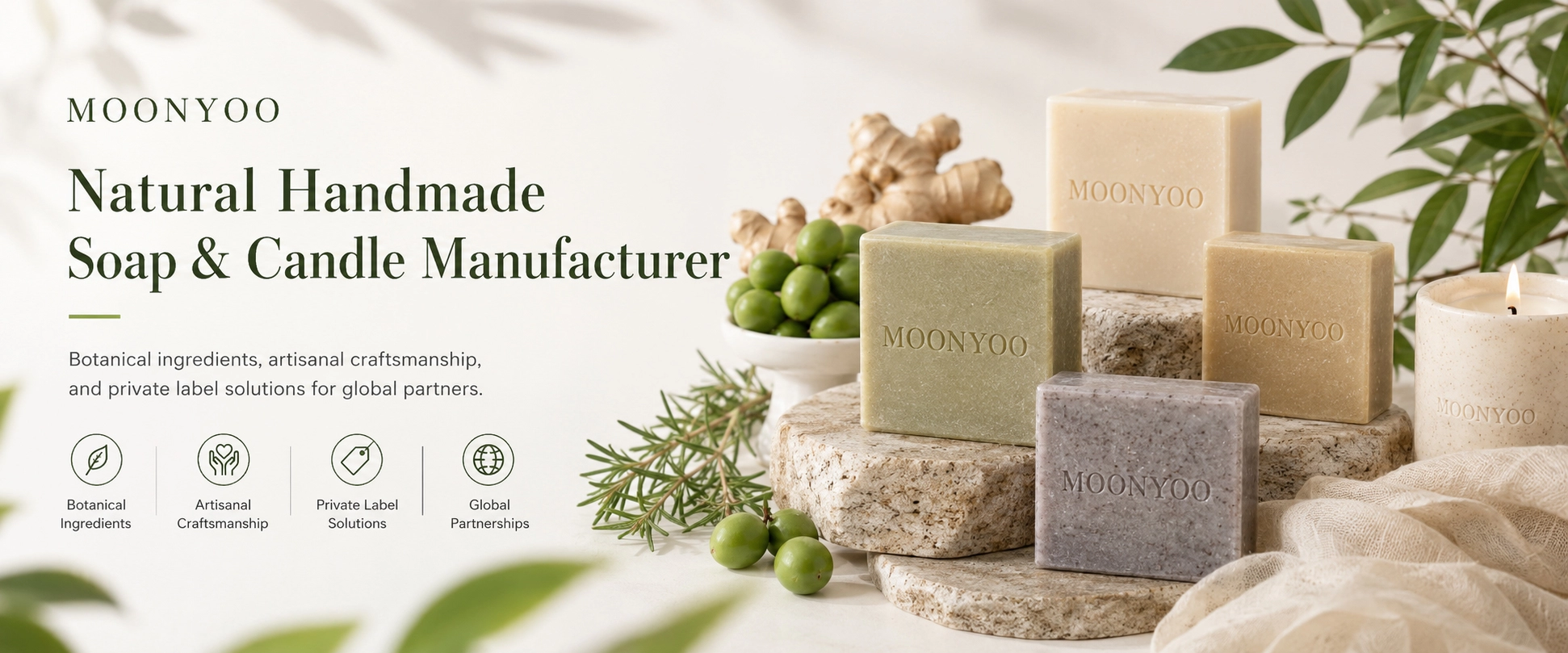
Private label, OEM and ODM are used almost interchangeably in sourcing conversations, and that looseness costs brands real money. The three models do not differ mainly in who physically makes the soap — in all three cases it is usually the same kind of factory. They differ in who owns three specific assets: the formula, the tooling, and the artwork. Those three ownership questions determine your lead time to first sale, your minimum order, and how expensive it is to walk away.
Quick answer: Private label means you buy an existing formula under your own brand. OEM means you bring your own formula and the factory manufactures to it. ODM means the factory designs the product, and you license or buy it for your brand. The decision is driven less by cost than by which assets you want to own — because the assets you own determine your switch cost later.
Why the labels get confused
The confusion is understandable, because the physical output is identical. A milled bar of soap with a botanical theme and a printed kraft sleeve looks the same on the shelf whether it was made under a private-label agreement or an ODM agreement. What differs is invisible: who decided the formula, who paid for the mould, and who owns the artwork file.
That invisibility is exactly why the distinction matters. A brand that believes it has commissioned an OEM programme when it has actually bought a private-label product will eventually discover that a competitor is selling the same bar under a different sleeve. A brand that has paid for ODM development without agreeing exclusivity may find the design reappearing in another market. Neither discovery happens at contract stage; both happen eighteen months later.
The three models in plain terms
Private label. You select from the manufacturer's existing product range. The formula, the shape and often the base artwork already exist. You apply your brand, your label data and your pack. Your order quantity can be relatively low because nothing new has to be created, and your time to first sale is short.
OEM (original equipment manufacture). You bring the product definition — the formula, the shape, the fragrance brief, the pack — and the manufacturer produces to your specification. You are buying manufacturing capacity and process control, not product development. Your first-article cycle is longer because the specification has to be translated into a running process, and your minimum order is higher because set-up is yours to absorb.
ODM (original design manufacture). The manufacturer develops the product — concept, formula, form, decoration and pack — and you take it to market under your brand. You are buying a finished design. This is the fastest route to a differentiated product if you lack in-house formulation, but the design assets are typically shared unless you negotiate otherwise.
Ownership matrix: formula, tooling, artwork
The table below is the decision core of this article. Read down the columns, not across the rows.
| Asset | Private label | OEM | ODM |
|---|---|---|---|
| Formula / recipe | Manufacturer owns; may be offered to other clients | You own, subject to a development or licence fee | Manufacturer owns; you licence the design for your brand |
| Mould / tooling | Manufacturer's existing stock | Normally you fund it; confirm who physically holds it | Manufacturer's tooling, reused for its own clients |
| Artwork & pack files | You own your brand layer; base template may be shared | You own the finished files — confirm file handover in writing | Manufacturer originates; you may hold a licence only |
| Exclusivity | Usually none unless specifically negotiated | Formula is yours, so exclusivity is inherent | Must be negotiated, and is usually time- or market-limited |
| Switch cost later | Low if you can re-source the same base | High — new factory must be briefed on your formula | Highest — you cannot take the design with you |
Two conclusions follow. First, exclusivity in a private-label arrangement is a contract term, not a property of the model — you can have it, but only if you buy it. Second, in an ODM arrangement the thing you are really purchasing is speed, and you should price that against the fact that you will not own the design.
Cost structure and where the break-even sits
Do not compare the three models on unit price alone, because they front-load different costs. Private label has the lowest up-front cost and the highest unit price for a comparable bar, because you are paying for a product that already exists and carries no development risk. OEM inverts this: a development and tooling charge up front, then a lower unit price because you are buying pure manufacturing.
ODM sits between them and behaves unusually. The development cost is embedded in the unit price rather than billed separately, which makes it look cheap at low volumes and comparatively expensive at high volumes once you have effectively paid for the development several times over.
| Cost element | Private label | OEM | ODM |
|---|---|---|---|
| Development / formulation | None billed | Charged up front | Embedded in unit price |
| Tooling | None — existing moulds | One-off charge | None |
| Artwork origination | Your cost, your designer | Your cost | Often included |
| Unit price behaviour | Flat, relatively high | Declines with volume | Margin-rich at low volume, poor at high |
| Minimum order | Lowest | Highest | Moderate |
The practical break-even question is therefore not "which model is cheaper" but "how many units will I sell before I would want to change something". If the answer is a small number and the product is unlikely to change, private label wins on simplicity. If you intend to own the product for years and reorder repeatedly, OEM's front-loaded cost amortises away and the lower unit price compounds.
Intellectual property and exclusivity
Three specific questions should be asked in writing before any model is chosen.
First: is the formula exclusive to me, and for how long? In private label the honest answer is usually no. In OEM it is usually yes by construction. In ODM it is negotiable, and the negotiation should specify a territory and a term, because indefinite global exclusivity on a stock design is rarely grantable.
Second: who holds the mould, and can I take it? If you funded the tooling, confirm that you may remove it, and confirm the physical condition it must be returned in. A mould that stays with the manufacturer is convenient but reduces your leverage at renewal.
Third: do I receive the finished artwork files? Ask for the native files, not a flattened export, and confirm the transfer in the contract. Brands that discover at reprint time that they hold only a flattened image of their own label have an avoidable problem.
Who carries compliance and labelling
Responsibility for label content follows the model more than most buyers expect. Under private label, the manufacturer has usually already established the ingredient declaration for the base product and you add your brand, net weight and market-specific statements. Under OEM the ingredient declaration is derived from your formula, so you must verify it line by line against what was actually produced. Under ODM the manufacturer supplies the declaration with the design, and your review is a check rather than a compilation.
In every model, the obligations that sit with the brand owner and not the factory are the market-access ones: destination-specific allergen or warning statements, importer identity, language requirements, and any registration of the cosmetic product in the target market. Confirm early which party is responsible for each line of the label panel, and put the answer in the brief.
Choosing your model
Work through the three asset questions in order. If you do not want to own the formula and you need to be in market quickly, choose private label and negotiate what exclusivity you can. If you have a defined product and you intend to own it, choose OEM and accept the up-front cost and higher minimum. If you need differentiation and do not have formulation capability in-house, choose ODM and negotiate territory and term on the design.
Then apply one test before signing: imagine you want to leave in two years. Which assets would you be leaving behind? If the answer is uncomfortable, that is the term you need to renegotiate now, while you still have leverage.
| If your priority is… | Choose | Because |
|---|---|---|
| Fastest route to market with minimal up-front spend | Private label | No development charge, no tooling, existing artwork templates |
| Owning the product and protecting it from competitors | OEM | The formula is yours, so exclusivity is inherent rather than negotiated |
| Differentiation without in-house formulation capability | ODM | The manufacturer delivers a finished design; you supply the brand |
| Testing demand before committing to tooling | Private label first, then OEM | Learn which SKUs and scents sell, then invest in tooling for those only |
| Multi-market distribution of one design | ODM with negotiated territory rights | Design rights are licensed by territory, so they must be requested |
Frequently asked questions
Is private label always cheaper than OEM?
At low volumes, yes — there is no development charge and no tooling. At sustained high volumes the position can reverse, because you are paying a margin on a product you did not develop. The cross-over depends on the development charge and the unit price gap, so ask for both quoted on the same volume so the comparison is real.
Can I start with private label and move to OEM later?
Yes, and it is a common route. Use private label to test the market and learn your real demand, then commission OEM once you know which SKUs and which scent direction justify tooling. The risk to manage is that your early private-label pack and your later OEM pack look different enough to confuse existing customers, so keep the visual language continuous.
Does ODM mean I cannot sell in more than one market?
Not necessarily, but it must be negotiated. ODM designs are often licensed by territory because the manufacturer wants to place the same design with non-competing clients elsewhere. If multi-market rights matter to you, ask for them explicitly and expect to pay more or to accept a longer commitment.
Who owns the fragrance if the factory matched it for me?
This is a frequent grey area. If the factory developed the blend in response to your brief, ownership depends on what you agreed and who paid for the development. Settle it in writing, and if the scent is central to your brand, ask for an exclusivity term rather than relying on the assumption that a bespoke blend is automatically yours.
What is the single most important clause in any of these agreements?
The exit clause. Specify in advance what you may take with you, what must be destroyed, what you owe if you leave, and how the tooling and files are transferred. Most sourcing disputes are not about quality; they are about what happens when a relationship ends.
Next steps
Write down your answer to the three asset questions — formula, tooling, artwork — before you approach any manufacturer. Then request quotations for the same volume under each model you are seriously considering, so the comparison is like for like rather than intuition against intuition.
For the next stage, see our guides on writing an OEM soap specification sheet and on custom moulds, shapes and weight tolerances.